Quantifying Uncertainty in Spatial Environmental Models: Methods and Best Practices
Environmental models that operate over spatial domains carry uncertainty at every stage of their processing chain. Systematic methods for uncertainty quantification and interoperable standards are essential for defensible, reproducible outputs.
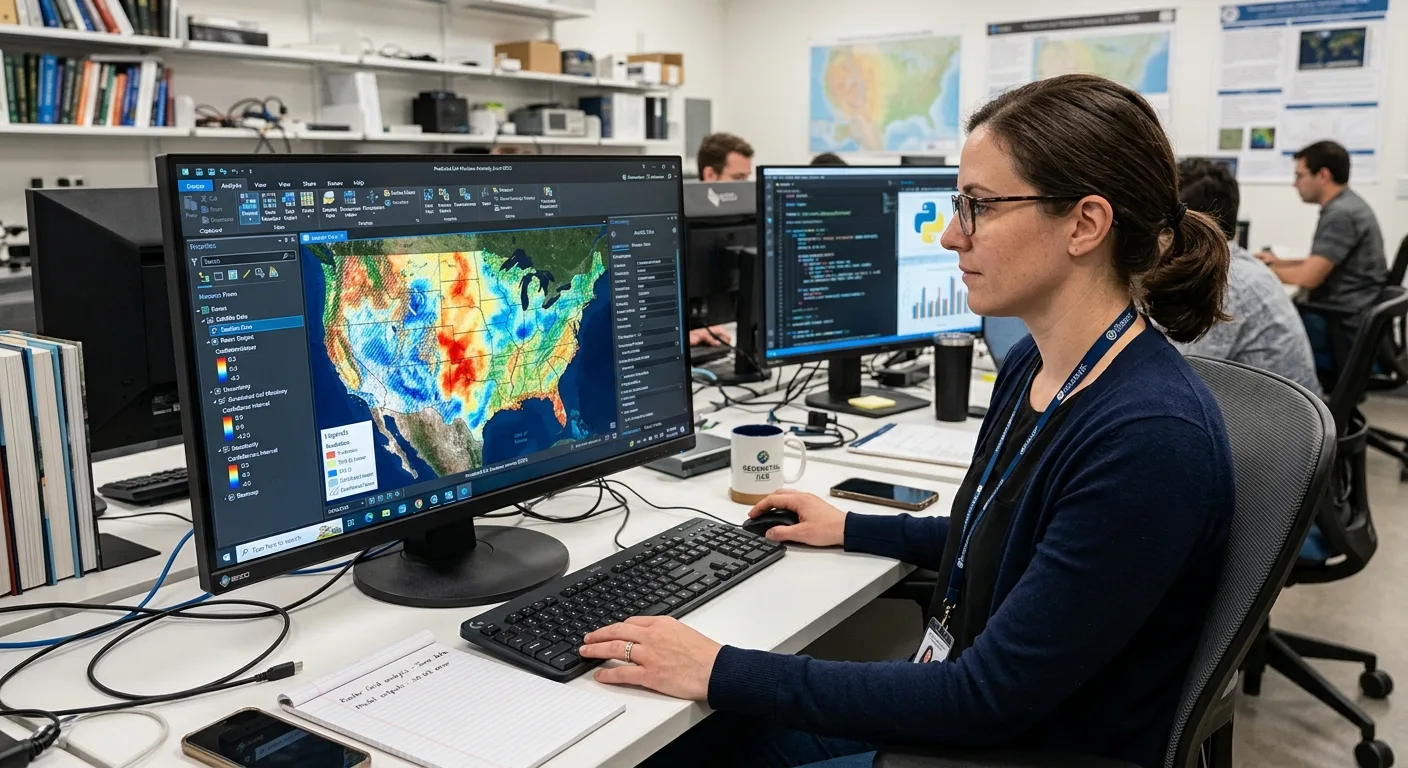
Environmental models that operate over spatial domains (hydrological forecasts, air-quality simulations, land-surface temperature retrievals) carry uncertainty at every stage of their processing chain. Sensor noise, interpolation errors, model parameter estimates, and boundary condition assumptions compound in ways that are rarely communicated to downstream users. Addressing this gap requires systematic methods for uncertainty quantification (UQ) and interoperable standards for expressing that uncertainty alongside the primary data product.
Why Spatial Context Makes Uncertainty Harder
Scalar UQ problems (estimating the uncertainty on a single measured temperature, for example) are well-understood in classical statistics. Spatial UQ adds dimensions that complicate standard approaches. Observations are correlated across space, so naive independent-sample assumptions overstate the effective information content of a dataset. A grid cell’s estimated soil moisture value is not independent of its neighbors; both share common input forcing data and the same model structure.
This spatial autocorrelation must be preserved when propagating uncertainty through a model chain. Failing to account for it leads to underestimated joint uncertainties across a spatial domain: a critical failure mode when the downstream use case involves regional aggregation, such as computing total basin runoff or area-averaged surface reflectance.
Two structural choices govern how spatial uncertainty is handled in practice:
-
Field-based representations store a full covariance or variogram model alongside the primary output. This is rigorous but expensive: for a global 0.1-degree grid, the covariance matrix has on the order of 10^10 entries, which is not tractable without approximations such as sparse precision matrices or Gaussian process approximations.
-
Ensemble representations replace the analytical covariance with a collection of equally-plausible realizations drawn from the joint distribution. Ensembles are more portable (each member is a valid spatial field that can be fed directly into a downstream model) and their summary statistics converge to the true moments as ensemble size grows.
Monte Carlo Propagation Through Model Chains
Monte Carlo (MC) propagation remains the most general method for UQ in complex model chains because it requires no analytical gradient information and handles non-linear and discontinuous models naturally. The workflow for a spatial MC experiment follows three steps.
First, define a probabilistic description of each uncertain input. For satellite-derived land-cover classifications, this might be a per-pixel confusion matrix that encodes the probability of each class. For a digital elevation model (DEM), it might be a spatially correlated Gaussian error field with a known semivariogram.
Second, draw N realizations from the joint input distribution. When inputs are spatially correlated, drawing must respect that structure: sequential Gaussian simulation or Cholesky decomposition of a local covariance approximation are standard approaches.
Third, propagate each realization through the full model chain and collect the ensemble of outputs. Summary statistics (mean, standard deviation, quantiles, probability of exceedance) can then be computed from the output ensemble at each grid cell.
The main limitation of MC propagation is computational cost. For high-fidelity atmospheric or hydrological models with run times measured in hours, generating even a modest ensemble of 100 members is prohibitive without dedicated high-performance computing resources. Surrogate modeling (replacing the expensive simulation with a fast statistical emulator trained on a small design-of-experiments sample) is the standard mitigation strategy. Polynomial chaos expansions and Gaussian process emulators are widely used in geophysical applications.
Interoperability and the Uncertainty-Enabled Model Web
Quantifying uncertainty within a single modeling system is necessary but not sufficient. Modern earth observation workflows are composed chains of web-accessible processing services (a sensor data archive, a land-surface model, an atmospheric correction service, a spatial aggregation step) each operated by different organizations using different software stacks. Unless uncertainty information is encoded in a machine-readable format that each service can consume and produce, the chain breaks: uncertainty generated in one service is discarded at the next service boundary.
The UncertWeb project (2010-2013), funded under the European Commission’s Seventh Framework Programme, addressed this directly. The project defined a set of uncertainty encoding profiles layered on top of existing OGC web service standards (WPS, WFS, WCS) so that a processing service could declare the uncertainty representation it accepts as input and the representation it produces as output. This enabled automated composition of model chains that preserved uncertainty end-to-end, integrated within the Global Earth Observation System of Systems (GEOSS).
Key design decisions from that work remain instructive. Uncertainty was classified by type (random, systematic, and structural) and each type was assigned a distinct encoding. A processing service that introduced systematic bias of known magnitude encoded that as a separate uncertainty component, not merged with random noise, so that downstream aggregations could handle each component appropriately.
Metadata Standards for Operational Deployment
For uncertainty information to be operationally useful, it must travel with the data through storage, catalog, and visualization systems, not only through processing pipelines. ISO 19115 geographic metadata allows uncertainty fields to be documented at the dataset level, but does not support per-observation or per-pixel uncertainty encoding. Observation and Measurement (O&M, ISO 19156) is more expressive and can represent a measurement as a probability distribution rather than a point value.
In practice, operational systems often use a simpler convention: a companion layer or band that encodes a per-pixel uncertainty estimate (commonly one standard deviation or a 90th-percentile confidence interval) alongside the primary data variable. NetCDF-CF conventions support this pattern through the ancillary_variables attribute. When the companion layer is generated correctly (accounting for spatial correlation) this approach is tractable and widely supported by downstream visualization and analysis toolchains.
What is frequently missing from operational products is documentation of the uncertainty model: what assumptions were made about input error structure, what correlation lengths were assumed, and how structural model uncertainty was handled. Without this provenance, the companion uncertainty layer cannot be correctly interpreted in a downstream propagation step. Data producers should treat uncertainty model documentation with the same rigor as algorithm theoretical basis documents (ATBDs).
Validation Against Independent Observations
Uncertainty estimates derived from model propagation must be validated against independent observations before being treated as reliable. A well-calibrated uncertainty estimate should satisfy the property that a stated 90% confidence interval contains the true value 90% of the time when evaluated over a large independent validation sample. This is the coverage criterion.
Common validation failures in spatial environmental models include:
- Underestimation of structural model uncertainty: when the only uncertainty tracked is input noise, ignoring the fact that the model itself is an approximation of physical processes.
- Failure to account for representativity error: the difference in spatial support between point observations used for validation and the grid cell values being validated.
- Temporal autocorrelation in the validation set: using validation observations drawn from a continuous time series without accounting for temporal dependence, which inflates the apparent sample size.
A rigorous validation workflow splits the independent observation set into subsets that span different climatic regimes, land cover types, and seasons, and checks coverage separately for each subset. Spatial maps of coverage failure are a diagnostic tool for identifying where the uncertainty model is most deficient.
Connecting UQ to Decision-Making
Uncertainty quantification is not an end in itself. Its value is realized when decision systems use it correctly: propagating it into risk assessments, using it to trigger additional data collection when uncertainty exceeds a threshold, or presenting it to analysts in forms that support rather than overwhelm interpretation.
For further reading on interoperability standards developed during the UncertWeb project, see the archived UncertWeb project resources and the associated publications on OGC uncertainty encoding profiles. Related topics on this site include building interoperable geospatial web services with uncertainty metadata and the model web architecture for global earth observation.